
Experts agree that they will have a particular impact on business in the next five to ten years, and their combined use can significantly change the technology and business paradigm.
How blockchain and AI are interconnected
AI providers and producers can open up new opportunities using blockchain technology, while blockchain has every chance to improve existing AI projects (for example, reduce the capital costs of AI services, etc.).
Common blockchain and AI integrations include:
Transparent data source
Having enough data is very important for training AI applications. Since the blockchain is the most transparent technology in existence, it positions itself as a reliable source of data, and thanks to node traceability, any information can be verified quite effectively.
Autonomous system
Decentralized ledger technology ensures that AI application operations are processed by a huge number of servers. An autonomous decentralized system that can manage AI training and operations without oversight or, in rare cases, sabotage by external parties.

Privacy Protection
Cryptography techniques, such as aliases, for example, enhance privacy throughout the network in which AI operations take place. Having a strong privacy system in place is very important for a business that trains and delivers AI systems due to the competitiveness and complexity of technology.
Distributed computing power
Training and support of AI technologies require large capacities. Blockchain technologies take care of the maintenance of first-class computers and allow individual devices to do this work. In addition to limited space, blockchain technologies also provide a reduction in rising hardware, storage, and maintenance costs.
Safety
Blockchain smart contracts are not secure, as evidenced by repeated hacks in industry projects. Since the technology revolves around the rigidity of contracts, any loopholes already introduced can be used to harm applications. Artificial intelligence is used to create smart contracts that are more secure than traditional ones, thus minimizing vulnerabilities.

Data Reading Efficiency
Blockchains are often limited in query performance, and for the most part, blockchain applications sacrifice read efficiency to achieve a more write-intensive approach with level DB, a write-intensive database management system.
Using artificial intelligence technologies, data storage methods can be improved for use in blockchains. The proposed new TTA-CB protocol reduces the problems of data storage technologies with the PSO algorithm. Through rigorous testing and training, AI has been able to improve the data query speed of blockchain applications.
Smart data networks
Large projects require the processing of huge amounts of data. In the traditional approach, data transactions are routed through a centralized system that controls the process. Although this process is not as efficient as it could be with the joint integration of blockchain and AI.
Distributed intelligent data networks overcome the information barrier that arises through the use of a centralized approach. Sharing data between multiple people or even projects can be more efficient and cost-effective.
Internet of vehicles
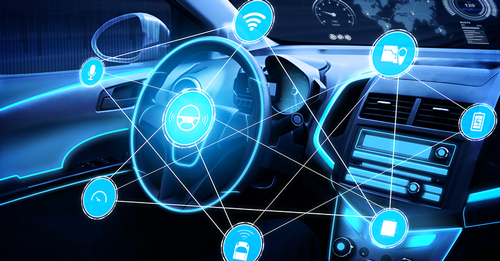
Smart vehicles use AI to train a model that keeps users steerable and safe. A huge amount of data is used to train the model, but there is a likely trust and security issue that could compromise the whole point of smart vehicles if they fall into the wrong hands.
Blockchain technology mitigates the problem by being transparent, encrypted, and immutable.
Supply chain management
Traditional supply chain management systems rely heavily on mutually exclusive operations, which often fail to convey the latest status of a product in the supply chain. Due to centralization, the whole process requires communication with one node, which forwards information to other operational parts. Using blockchain and artificial intelligence, the entire process can be automated and distributed to make it faster and more efficient.
Healthcare
The healthcare sector needs data mobility and privacy more than any other sector. But the healthcare sector is also more prone to cyberattacks due to the fact that it is involved in sensitive issues related to human lives.
Blockchain technology can ensure that sent or received data remains private, and AI solutions can eliminate security threats before attackers discover them.
Financial operations
Cryptocurrencies are already being used in financial transactions around the world. Many well-known financial institutions are also considering implementing blockchain technology in their core operations. And since AI is already being used in stock trading and other financial transactions, the benefits of integrating blockchain and AI in the financial sector are enormous.